How to decouple devaluation from debt for action on net zero
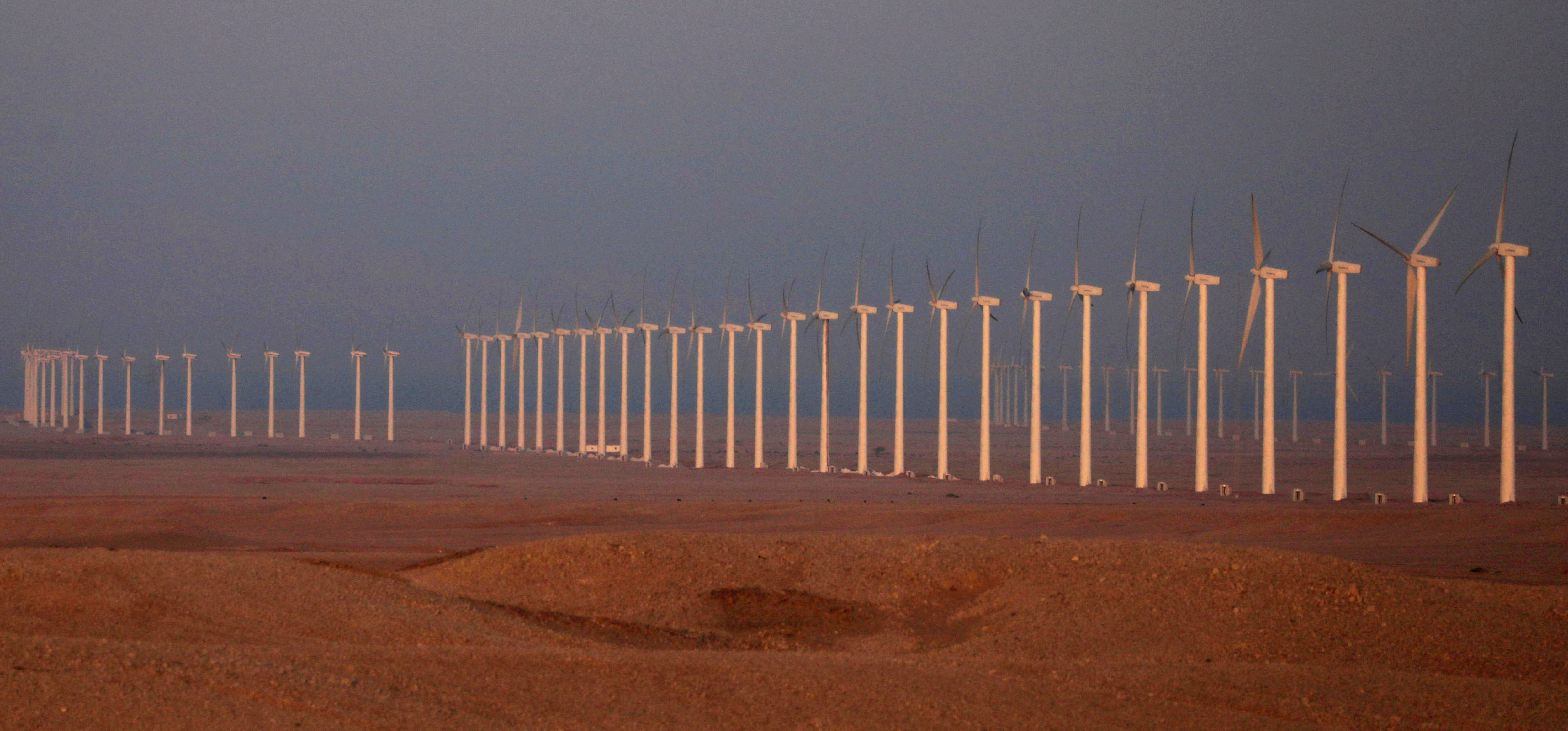
Egypt's experience shows how a multi-layered currency risk-sharing facility can unlock finance for net zero. Image: Reuters/Amr Abdallah Dalsh
Seham Farouk
Senior Expert, Sustainable Finance and PFM, Minister of Finance Technical Office, Egypt Government- The global transition to net zero faces structural challenges in emerging markets where efforts often rely on a foundation of foreign currency debt.
- Developing economies will need $2.4 trillion a year by 2030 for the energy transition, yet many of the same countries face a 'green debt trap'.
- As Egypt's experience shows, a multi-layered currency risk-sharing facility can help countries unlock the global trillions needed to achieve net zero.
The global transition towards a net zero future is hitting a structural wall in emerging markets, where sustainable climate goals are being built on a foundation of foreign currency debt.
Green infrastructure projects – solar farms, wind capacity, clean transport – generate revenues in local currency, yet their financing remains dominated by the US dollar and the euro. This mismatch turns exchange rate volatility into a primary driver of sovereign debt distress.
When a currency depreciates, the dollar debt stays constant but soars in local terms – automatically inflating the debt-to-GDP ratio and compressing fiscal space, as a result of increasing the debt service which eventually will increase the financing needs.
The financing challenge is immense: the High-Level Expert Group on Climate Finance developing countries alone will need $2.4 trillion a year by 2030 for the energy transition, adaptation and natural capital restoration.
On any estimate, domestic markets cover only half. The rest must come from hard-currency international capital, landing on local currency balance sheets and leaving sovereign borrowers exposed to shocks they cannot control.
The African Development Bank’s African Economic Outlook 2026 identifies this directly: dollar-denominated Eurobonds – sovereign bonds issued in foreign currency on international markets – without adequate currency hedging, combined with rising interest rates and institutional weaknesses, are primary structural drivers of sovereign risk across Africa.
Climate ambitions did not create this green debt trap but they will deepen it without structural reform.
How to solve the ‘green debt trap’
The international financial system has acknowledged this problem without yet solving it. The conventional response forces a binary choice. Full hedging is prohibitively expensive: for long-maturity renewable projects, costs routinely exceed the concessional rates at which development finance is offered.
As ImpactAlpha documents, every landmark blended finance innovation of the past decade – the International Finance Corporation’s (IFC) Managed Co-Lending Portfolio Program, the African Development Bank’s (AfDB) Room2Run, the European Bank for Reconstruction and Development’s (EBRD) Financial Institutions Portfolio Programme – mobilized hard-currency capital while borrowers’ revenues stayed local.
Currency risk was also acknowledged but not addressed. Full exposure leaves sovereigns absorbing shocks of unpredictable magnitude. With debt-to-GDP ratios across key emerging market sovereigns projected to rise by more than 5% between 2023 and 2030, it is urgent to rebalance financing strategies and reduce systemic vulnerabilities.
The multi-layered currency risk-sharing facility (CRSF) offers a way forward. Its core innovation is simple: rather than asking one actor to absorb all currency risk – or pay to eliminate it entirely – the CRSF distributes volatility across three tiers calibrated to the probability and severity of exchange rate movements.
Routine fluctuations are handled by markets. Moderate shifts are absorbed by the sovereign, compressing the cost of protection for the whole structure, while extreme devaluations are backstopped by international partners through a digital guarantee executed instantly via smart contracts, with no upfront capital required unless the threshold is breached.
The result? A self-reinforcing architecture that is cheaper than full hedging, safer than full exposure, and structured to attract long-horizon institutional capital from pension funds, life insurers and sovereign wealth funds looking for green financing.
The facility operates through a three-tiered mechanism that assigns risk to the party best positioned to manage it:
- Commercial layer: Standard market instruments like currency swaps and forward contracts absorb routine, day-to-day fluctuations through existing private market infrastructure, requiring no public subsidy.
- Institutional layer: The sovereign absorbs moderate exchange rate shifts up to a predefined band (for example, 5% annually), lowering the overall cost of capital, demonstrating fiscal commitment and effectively mitigating the moral hazard often associated with full external insurance.
- Tail-risk shield: For tail-risk events, international partners – including global multilateral development banks (MDBs) and multilateral financial institutions – provide a protective guarantee triggered by smart contracts. This requires no upfront capital from guarantors; by encoding trigger conditions in a tamper-proof, automatically executing protocol, it eliminates bureaucratic delay during a currency crisis when speed and certainty are critical to maintaining investor confidence.
Financial innovations that serve as precedents
Three specific innovations in the global financial landscape validate the mechanics of this proposed framework.
The Uganda Development Bank’s Currency Risk Sharing Facility (2024) addresses the structural dilemma of local-currency lending using foreign-currency debt by employing a tiered risk-distribution mechanism, involving hedge providers, internal retention buffers, and donor-backed guarantees, for tail-end risks. Preliminary modelling confirms its financial sustainability, as large-scale depreciations are statistically infrequent.
Meanwhile, Vietnam’s Scaling Up Energy Efficiency Risk Sharing Facility 2024, backed by the World Bank and the Green Climate Fund, deploys a partial credit guarantee to de-risk commercial lending for industrial energy efficiency. Its 2024 Operations Manual provides a robust governance framework that codifies stringent eligibility criteria, defined trigger conditions, and standardized monitoring obligations – offering a scalable operational blueprint for managing contingent liabilities within a sovereign-level CRSF.
Third, the IFC’s Risk Sharing Facility (Global) reimburses financial institutions for losses exceeding a predefined first-loss threshold, requiring no upfront capital unless losses are actually incurred. By decoupling routine risk from tail-risk, this model reduces protection costs and expands lending into underserved markets, and serves as the direct operational precedent for the tail-risk shield.
What the CRSF delivers for net zero
A multi-layered CRSF offers systemic advantages that extend beyond climate finance to the broader sovereign balance sheet. Fiscal sustainability and reduced costs lead to:
- Eliminating risk premiums: By capping currency downside, the CRSF removes the exchange rate risk premium from project returns, ensuring accurate, fundamental-based pricing.
- Sovereign-level protection: Unlike project-specific instruments, the CRSF operates at the sovereign debt portfolio level. By absorbing currency-driven inflation before it impacts the national balance sheet, it directly lowers debt-to-GDP ratios and protects fiscal consolidation paths.
- Enhanced creditworthiness: Actively managing exchange rate exposure through a structured, multilaterally-backed facility signals fiscal discipline. This institutional credibility reduces the sovereign risk premium, lowering the cost of all public debt issuances.
- Creating a virtuous cycle: Lower financing costs expand fiscal space for productive investment, which attracts further private capital, fostering a self-reinforcing cycle of creditworthiness and sustainable growth.
Egypt highlights the benefits of the CRSF in practice
Egypt offers a definitive case study for the benefits of the CRSF. Due to current global financial conditions, the country faces a 'green debt trap,' where a robust pipeline of renewable energy projects is paradoxically constrained by hard-currency commitments and local-currency revenues, making the currency mismatch structural rather than incidental.
However, Egypt is well positioned to break this cycle. Its Nexus of Water, Food and Energy (NWFE) programme has already mobilized more than $10 billion for solar, wind and clean transport, targeting 10 gigawatts of renewable capacity by 2028. With macroeconomic stability being actively managed, and foreign reserves rebuilt to $53.13 billion, as of May 2026, Egypt serves as the ideal pilot for the CRSF to become a global blueprint.
The CRSF implementation in Egypt offers four strategic advantages:
- Fiscal sustainability: By distributing currency risk across tiers rather than accumulating it at the sovereign level, the facility protects Egypt’s entire public debt portfolio. Even a modest reduction in the sovereign risk premium translates into hundreds of millions of dollars in annual financing cost savings. A structured, multilaterally-backed currency risk facility signals fiscal discipline to credit rating agencies and bond investors alike, compressing the risk premium demanded on all Egyptian sovereign issuances – Eurobonds, green bonds, and sukuk – and reducing the overall cost of public financing.
- Lower borrowing costs: The sovereign’s institutional layer acts to compress guarantee costs across the entire NWFE portfolio, optimizing the efficiency of green financing.
- Domestic investment mobilization: Local financial institutions gain access to de-risked green portfolios, enabling a transition toward sustainable local-currency climate lending.
- Foreign investment attraction: By stabilizing returns and removing the exchange rate premium, the CRSF makes Egypt’s renewable pipeline more attractive to long-horizon institutional capital.
A replicable blueprint for the Global South
Egypt’s challenge is not unique. The African Economic Outlook 2026 documents sharp currency depreciations across Africa in 2023-24, which have compressed fiscal space and raised debt-service burdens continent-wide.
From Sub-Saharan Africa to Southeast Asia and Latin America, the structural trap is identical: hard-currency debt including Eurobonds, local-currency revenues, and exchange rate shocks that domestic policy cannot unilaterally prevent. The CRSF is specifically designed for replication across diverse currencies and institutional frameworks. While the 2025 Sevilla Commitment called on MDBs to scale local currency lending, the CRSF provides the concrete mechanism to achieve this.
By institutionalizing the CRSF – beginning with a pilot anchored in Egypt’s NWFE programme – we can stabilize returns for investors, unlock sustainable foreign direct investment, and enable policy-makers to mobilize long-term funding without breaching debt ceilings.
We can shift the Global South from a passive absorber of currency risk to an active architect of resilient climate finance, funding net zero on its own terms. Drawing on Egypt’s experience, we call on MDBs, bilateral donors and development finance institutions to co-design the CRSF governance framework, anchor the first pilot in Egypt's NWFE programme, and commit the tail-risk guarantee capacity that will make it operational.
Solving the green debt trap is essential to achieving net zero. Without it, the trillions needed for the energy transition will remain locked away from the countries that need them most.
The views expressed in this article are those of the authors and do not necessarily reflect the official policy, position, or views of authors who are affiliated.
Don't miss any update on this topic
Create a free account and access your personalized content collection with our latest publications and analyses.
License and Republishing
World Economic Forum articles may be republished in accordance with the Creative Commons Attribution-NonCommercial-NoDerivatives 4.0 International Public License, and in accordance with our Terms of Use.
The views expressed in this article are those of the author alone and not the World Economic Forum.
Stay up to date:
The Net Zero Transition
Related topics:

Forum Stories newsletter
Bringing you weekly curated insights and analysis on the global issues that matter.
More on Climate Action and Waste Reduction See all

Kate Whiting
July 29, 2026


