Why seasonal eating could be our best defence against climate instability
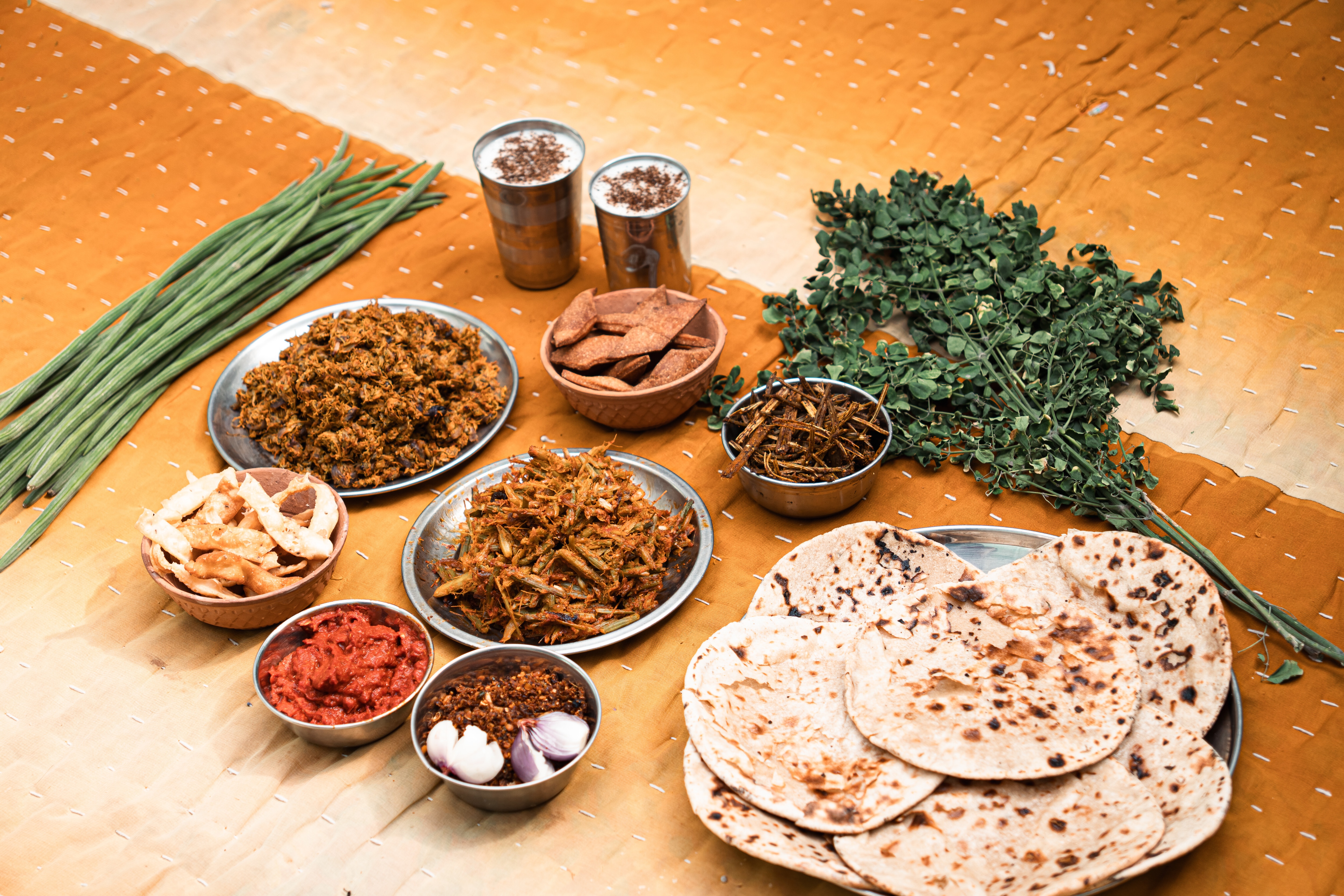
Past cultures and traditions show the benefits of seasonal eating rather a year-round diet Image: Kashish Nawalkha for The Kindness Meal
- Modern food systems have disconnected food from seasonality, geography and local ecology, creating increasingly uniform diets year-round.
- A look at Indigenous food cultures around the world reveals how communities have historically adapted their diets to climate, scarcity and seasonal change.
- As climate instability increases, preserving seasonal and indigenous food knowledge may become essential for building more resilient food systems.
In parts of Rajasthan's Thar Desert in India, a shrub locally known as “lana” (Haloxylon salicornicum) appears only during winter and the slightest rise in temperature burns it away.
For generations, communities have gathered and mixed it with “bajra” (pearl millet) flour to make “dhokli,” a seasonal dish believed to warm the body, eaten during the coldest months of the year.
This pairing is a hyperlocal example of the relationship among food, body and seasonality, factors that once dictated diets across much of the world.
Communities adapted to eat what their landscapes offered and what their body needed as seasons changed. However, we understand food systems to operate quite differently now.
Industrial agriculture, long-distance trade and global supply chains have made many foods available regardless of season or geography, pushing the locally grown, seasonally available produce out of public markets and personal memory.
As climate change introduces greater uncertainty into agricultural production, researchers increasingly point to diversity as an important component of resilience.
”Diets traditionally have shifted with the body’s needs
If we zero in on the Thar Desert, often imagined as barren and empty, we find that it has long sustained populations that maintain an intimate knowledge of seasonal change.
Summer was when native melon varieties such as “matira” and “chibbad,” native cucumbers such as “kakdi,” and fruits and berries such as “peelu” and “ber” (Indian Jujube) appeared, with ample water content and cooling properties that the body needed during the hottest months of the year.
Communities relied on these foods alongside “chaach” (buttermilk) and other seasonal ingredients during periods of extreme heat.
A summer lunch in Rajasthan had little in common with a winter plate, as the body's needs shifted dramatically. Millet-heavy meals became more common in winter, while seasonal greens appeared and ingredients such as lana were sought after in local kitchens.
Preservation was another layer in the diversity of food and adaptation. Ker, khachri, gwar phali and various legumes were dried and stored for months when fresh foods became scarce.
These practices emerged from environmental constraints but they also reflected detailed knowledge of local ecosystems and an understanding of the seasonal variability the human body demands.
Similar patterns can be found across the world. Across the Arctic, Indigenous communities timed hunting and fishing practices around animal migrations and changing ice conditions. Along the Amazon basin, food systems followed seasonal flooding cycles that determined when fish, fruits and crops became available.
How foods lost seasonal variety
Over the past century, refrigeration, industrial agriculture and long-distance trade have dramatically reduced dependence on seasonal cycles. Foods that were once available for only a few weeks or in certain geographies not at all could now be consumed year-round.
Consumers gained greater choice, while food systems became more efficient, predictable and capable of feeding growing populations.
At the same time, diets became increasingly standardized. Government procurement systems, market incentives and industrial agriculture encouraged the widespread cultivation and consumption of a smaller number of staple crops.
According to the Food and Agriculture Organization (FAO), wheat, rice and maize now provide around 42% of the world's calories.
The shift improved food access for millions of people and reduced many forms of vulnerability. However, it also contributed to increasingly similar diets across very different geographies and as a result, an entire food knowledge system was systematically ruled out.
The story of lana illustrates how these transitions often occur. The shrub still grows in parts of the desert, yet few know how to prepare it because the surrounding food system has completely changed. Traditional recipes depended on small grains and millets, such as bajra, remaining part of everyday diets.
However, as wheat and rice became more prominent through procurement systems and changing consumption patterns, bajra cultivation declined in many areas. Over time, dishes built around the grain became less common and knowledge of the associated ingredients began to disappear alongside them.
Whether every traditional claim associated with such foods can be validated through contemporary nutritional science is a separate question. What is harder to dismiss is the fact that these practices emerged through generations of observation and adaptation to the same environment.
Food cultures functioned as knowledge systems, preserving information about seasons, landscapes and available food sources long before such observations were formally documented.
Seasonal eating could increase food security
Historically, seasonal food cultures encouraged communities to draw upon a wider range of ingredients, preservation techniques and food sources. They embedded knowledge about local ecologies and how diets could adapt to changing environmental conditions.
As climate change introduces greater uncertainty into agricultural production, researchers increasingly point to diversity as an important component of resilience. Diverse food systems reduce dependence on a limited number of crops and create multiple pathways for communities to access food.
The consequences of dietary standardization extend beyond disappearing recipes. Contemporary debates around interventions such as rice fortification reveal that nutritional deficiencies that are often addressed through standardized solutions might not be the blanket solution we hope them to be.
The question is not whether one approach should replace the other but whether modern food systems can keep pretending that they can afford to lose diversity altogether.
This is not a call to return entirely to older food systems. Many emerged from conditions of hardship and scarcity that people understandably wished to move beyond. But when diets become detached from seasonality, they often lose the diversity of foods, ingredients, and ecological knowledge that seasonal systems once encouraged.
As climate instability increases and food systems become more fragile, older forms of seasonal knowledge may once again be relevant, not as relics of the past but as part of practical solutions for adaptation.
Don't miss any update on this topic
Create a free account and access your personalized content collection with our latest publications and analyses.
License and Republishing
World Economic Forum articles may be republished in accordance with the Creative Commons Attribution-NonCommercial-NoDerivatives 4.0 International Public License, and in accordance with our Terms of Use.
The views expressed in this article are those of the author alone and not the World Economic Forum.
Stay up to date:
Food Systems
Related topics:

Forum Stories newsletter
Bringing you weekly curated insights and analysis on the global issues that matter.